
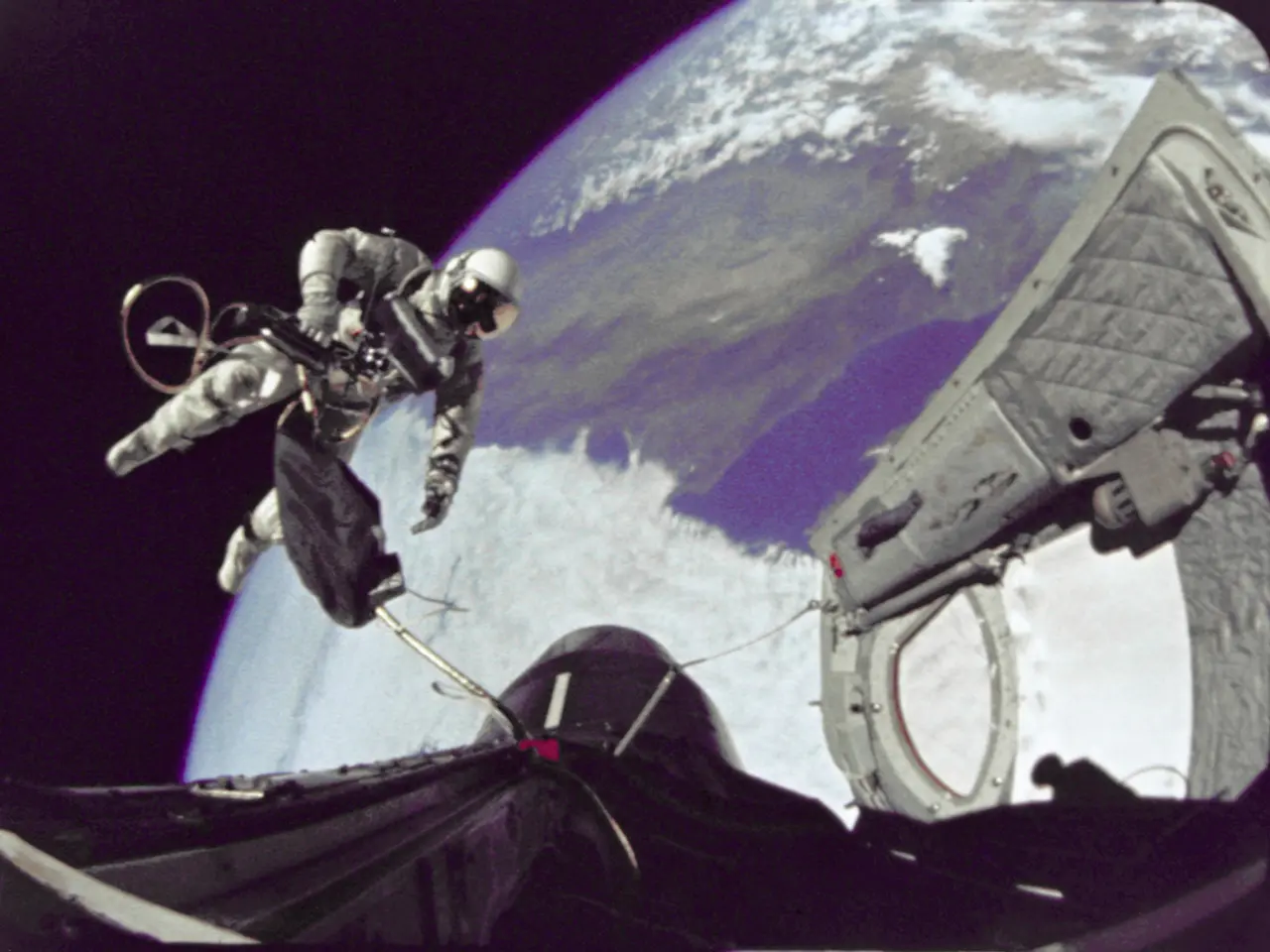
Crew of Four Space Travelers Touch Down on Earth Following Water Landing from Space Station
The SpaceX Crew Dragon capsule, owned by billionaire Elon Musk, successfully returned to Earth on Saturday, concluding a nearly five-month mission aboard the International Space Station (ISS). The international crew of four astronauts, including U.S. astronauts Anne McClain and Nichole Ayers, Japan's Takuya Onishi, and Russian cosmonaut Kirill Peskov, splashed down off California's coast at 8:44 a.m. local time.
During their time on the ISS, the crew conducted numerous scientific experiments, including studying plant growth, how cells react to gravity, and the effect of microgravity on human eyes.
As the Crew Dragon began its reentry into Earth's atmosphere, it experienced speeds of approximately 17,500 mph (about 28,000 km/h). During the critical phase of reentry, the capsule's outer surface heated up intensely due to friction with the atmosphere, reaching temperatures as high as about 3,500°F (1,927°C) according to recent Crew-10 mission data, and around 2,000°C based on Axiom-4 mission reports.
This extreme heat was managed by SpaceX’s PICA-X heat shield, an ablative material that absorbs and sheds heat by burning away the surface gradually. The capsule also experienced up to about 5 Gs during descent, but advanced autonomous flight controls ensured crew safety and mission success.
Communication with the capsule was lost for about 7 minutes during peak heating and plasma formation, before the capsule slowed to roughly 16 mph by splashdown after deploying parachutes in stages around 18,000 feet and again near 6,500 feet altitude.
The crew will now fly to Houston to be reunited with their families. NASA acting Administrator Sean Duffy praised the successful mission, while McClain expressed her farewell to the ISS as "bittersweet" due to potential inability to return.
Meanwhile, NASA announced last month that it would lose approximately 20% of its workforce, around 3,900 employees, due to cuts from Trump's federal workforce reduction efforts. The agency also announced that Butch Wilmore, who was initially stranded on the ISS due to Starliner's propulsion problems, has decided to retire after 25 years of service at the U.S. space agency.
Looking forward, Trump has prioritized crewed missions to the Moon and Mars, emphasizing the dependence of these missions on international cooperation and long-term commitment. Last week, a new crew consisting of U.S. astronauts Zena Cardman and Mike Fincke, Japan's Kimiya Yui, and Russian cosmonaut Oleg Platonov began a six-month mission on the ISS.
References:
[1] Space.com. (2021). SpaceX Crew Dragon reentry and splashdown: What you need to know. [online] Available at: https://www.space.com/spacex-crew-dragon-reentry-splashdown-what-you-need-to-know.html
[2] NASA. (2021). SpaceX Crew-10's return to Earth. [online] Available at: https://www.nasa.gov/feature/spacex-crew-10s-return-to-earth
[3] Ars Technica. (2021). SpaceX's Crew Dragon reentry: How it works. [online] Available at: https://arstechnica.com/science/2021/04/spacexs-crew-dragon-reentry-how-it-works/
[4] Space.com. (2021). SpaceX Crew Dragon reentry: What you need to know. [online] Available at: https://www.space.com/spacex-crew-dragon-reentry-what-you-need-to-know.html
- The international crew included astronauts from various countries, such as the United States, Japan, Russia, and a prominent figure in the world of space-and-astronomy was also part of the mission.
- During their stay on the International Space Station (ISS), the crew carried out numerous experiments in various scientific fields, including general-news, artificial intelligence (AI), and space-and-astronomy.
- Upon returning to Earth, the crew faced extreme heat as the capsule reentered Earth's atmosphere, with temperatures reaching as high as about 3,500°F (1,927°C) according to recent mission data. This heat was managed by the capsule's PICA-X heat shield, an advanced technology component.
- In the future, NASA is planning to collaborate with international partners for crewed missions to the Moon and Mars, which will heavily depend on ongoing commitment and advancements in technology in both the national and international science communities.