
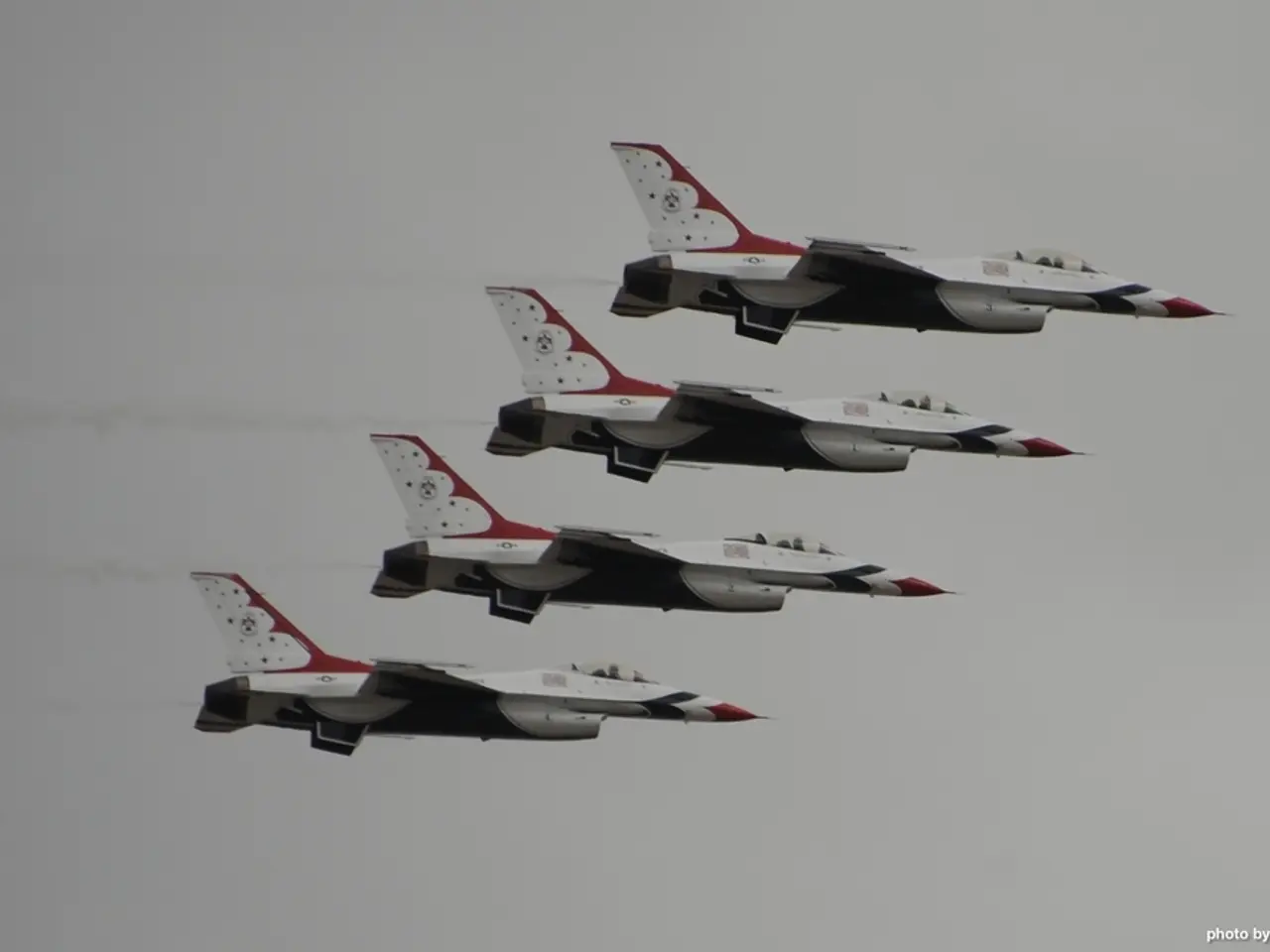
Europe's flagship fighter jet project considers Germany's plans to replace France as a key participant
In a significant development, tensions between France and Germany over the Future Combat Air System (FCAS) have reached a critical point, casting doubt on the future of the fighter jet project.
The FCAS, a joint program among France, Germany, and Spain, aims to replace the Rafale and Eurofighter Typhoon by 2040. However, recent friction between Berlin and Paris has posed a threat to the project's progress.
Sébastien Lecornu, the former armed forces minister in France, is seen as the key figure who could potentially bring Dassault Aviation to the negotiating table. Lecornu's actions could significantly impact the FCAS and potential fallback options with the U.K. and Sweden or a solo project with Spain.
German officials have been closely watching Lecornu's stance, as his actions could determine the course of the FCAS. Meanwhile, Andreas Schwarz, a Social Democratic lawmaker, has stated that a decision will have to be made by the German parliament about whether they need the FCAS.
Berlin is reportedly exploring replacing France with Sweden or the U.K. in the FCAS program. Sweden, no longer a part of the GCAP, could contribute to FCAS through Saab, which has long-standing expertise in avionics, sensors, and lightweight airframes.
On the other hand, Paris and Madrid have no disagreements regarding the FCAS project. In July, both parties agreed to try to iron out divergences in the fall and decide by the end of the year whether to move FCAS to Phase 2.
German Chancellor Friedrich Merz met with Spanish PM Pedro Sánchez and discussed FCAS, expressing concern that both parties are not advancing with the current situation and want a solution as soon as possible. No formal decision has been taken in Berlin about pursuing a Plan B for FCAS.
The German air force officials have briefed Bundestag lawmakers about the FCAS, and German defense media Hartpunkt reported that Dassault is pushing for an 80 percent share of the work on the Next-Generation Fighter (NGFW), triggering anger in Berlin.
French officials have denied Dassault's alleged demand for an 80 percent share, but seek more decision-making power specifically on the NGFW to avoid delays. The French minister directly involved in the FCAS negotiations, Sébastien Lecornu, is known in Berlin as the one limiting Dassault’s power to reach an agreement.
The U.K., led by BAE Systems, heads the rival Global Combat Air Programme, giving it a strong industrial base in stealth design and system integration. Germany is considering closer cooperation with Sweden or the U.K., or proceeding with Spain without France in the FCAS project.
A French official working on FCAS suggested that the current governance could be tweaked to allow for faster decisions, but no obvious solution has been found yet. German Chancellor Friedrich Merz's spokesperson Stefan Kornelius stated that the distribution of burdens and work in the FCAS project must be carried out in accordance with the contract.
The collapse of François Bayrou's government in a no-confidence vote paved the way for Sébastien Lecornu to become prime minister in Paris. The future of the FCAS project remains uncertain, with both France and Germany seeking a resolution to the current impasse.