
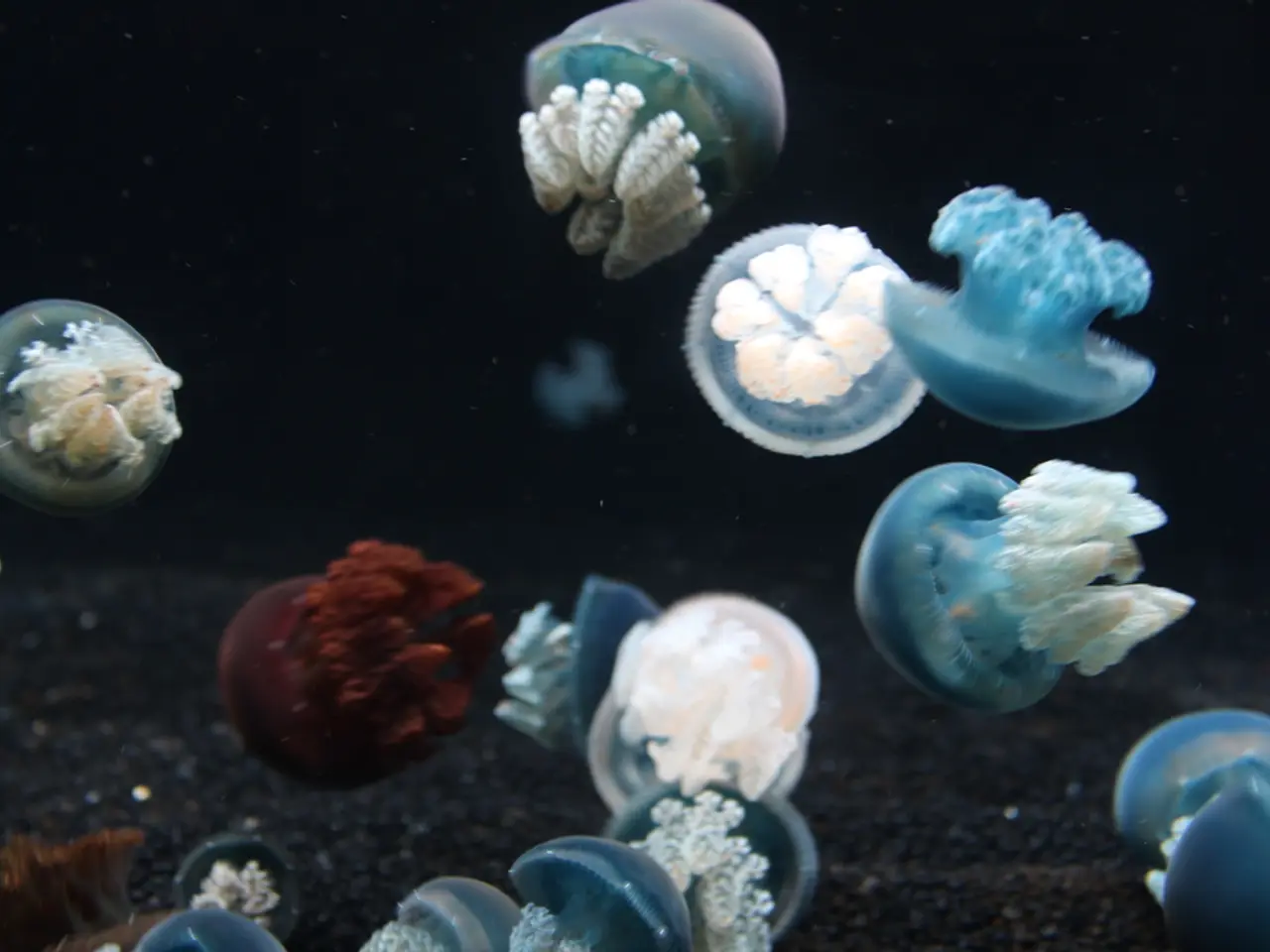
Jellyfish incapacitate France's largest nuclear facility, causing disruption.
Jellyfish Disruption at France's Largest Power Plant
The Gravelines power plant, France's largest nuclear facility, has temporarily halted power production due to a swarm of jellyfish clogging the water pumps. The incident occurred in the non-nuclear part of the plant, with four reactor blocks shutting down automatically.
The spokesperson for the plant's operator, EDF, reported a "massive and unexpected" jellyfish accumulation. Initially, three units were automatically shut down on Sunday evening, followed by the fourth early Monday morning. Despite the shutdown, the incident did not impact the overall power supply, as demand for electricity is lower in the summer.
This is not the first time such an incident has occurred. Previously, jellyfish have caused an atomic reactor to shut down in Sweden. The type of jellyfish involved in the Gravelines power plant incident is currently being investigated.
The spokesperson assured that the safety of the facility, its employees, and the environment was not at risk. They also indicated that the restarting of the reactor blocks at the Gravelines power plant would likely happen gradually.
Common causes for jellyfish clogging water pumps in nuclear power plants, including Gravelines, are massive and unpredictable swarms of jellyfish entering the seawater intake systems used for cooling. This has repeatedly caused automatic safety shutdowns at Gravelines and other coastal plants worldwide. Contributing factors include the location of nuclear plants on coasts that use seawater for reactor cooling, influxes of jellyfish populations influenced by rising sea temperatures and climate change, and the presence of invasive jellyfish species like the Asian Moon jellyfish.
Common solutions and mitigation strategies include regular cleaning and maintenance of intake filters and pumping stations, the implementation of jellyfish deterrence systems or barriers around water intakes, the use of automated monitoring and early-warning systems, research into alternative cooling technologies or modifications to intake design to reduce susceptibility to clogging, and operational protocols for rapid shutdown and restart to maintain safety without damage when blooms occur.
Despite the temporary disruption, the Gravelines power plant remains a vital part of France's energy infrastructure. Similar disruptions due to jellyfish have occurred at nuclear plants in Scotland (Torness), Sweden (Oskarshamn), and elsewhere, suggesting a broader emerging challenge linked to environmental changes.
In the meantime, other power plants could compensate for the outage at the Gravelines power plant. Maintenance work is currently being carried out on the other two units of the Gravelines power plant.
| Cause | Solution | |----------------------------------------------|----------------------------------------------------| | Massive jellyfish swarms clog cooling filters| Regular cleaning and filter maintenance | | Rising sea temperatures promote blooms | Monitoring systems and early warnings | | Jellyfish entry via seawater intakes | Physical barriers and jellyfish deterrents | | Invasive jellyfish species flourish in canals| Intake design improvements and alternative cooling |
- The temporary halt in power production at France's largest nuclear facility, Gravelines power plant, is a result of massive and unexpected jellyfish accumulation in the water pumps, causing four reactor blocks to shut down automatically.
- Climate change, including rising sea temperatures, might contribute to the increased occurrence of jellyfish swarms, which find their way into the seawater intake systems used for cooling, causing automatic safety shutdowns at coastal nuclear plants like Gravelines.
- Operators of nuclear plants, such as EDF at the Gravelines power plant, may employ measures to mitigate the effects of jellyfish on power production, such as regular cleaning and maintenance of intake filters, the implementation of deterrence systems, or research into alternative cooling technologies.
- The environmental-science community and the finance sector should collaborate to address the broader emerging challenges linked to the impact of climate-change on jellyfish populations and the disruption they can cause in the industry, particularly the energy sector, and take appropriate measures to shield power plants like Gravelines from future disruptions.